Blinds for Sliding Glass Doors: The Complete Guide
A sliding glass door is not a big window. It is a wall of glass that also happens to be a doorway people walk through several times a day, often carrying something. That single fact eliminates most window treatments before style enters the conversation, because anything you have to raise fully to step outside will end up permanently raised.
The coverings that work are the ones that move the same direction the door does.
Why sliding doors need side-to-side operation
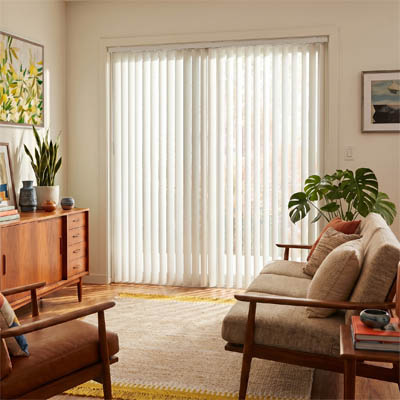
The rule is simple: The covering should open the way the door opens. A treatment that stacks to one side lets you uncover only the panel you are using, while the rest of the glass stays covered for privacy and light control.
Horizontal blinds and shades that lift vertically create the opposite problem. To use the door, you raise the entire covering, which exposes the whole wall of glass and defeats the point. There is one workable exception, covered further down.
Three practical requirements follow from daily use:
- Stack clearance: The covering needs somewhere to gather that does not block the opening.
- Handle clearance: The treatment has to sit forward of the door handle and lock so nothing catches.
- Durability: A door covering gets handled far more often than a window covering, so the operating mechanism matters more.
Vertical blinds: The default for a slider
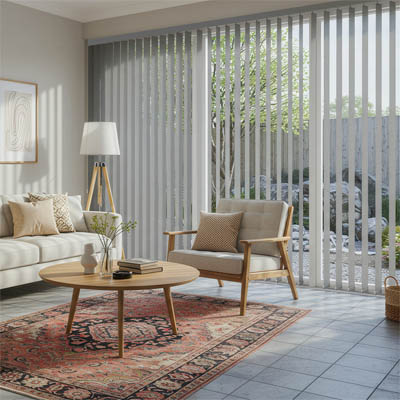
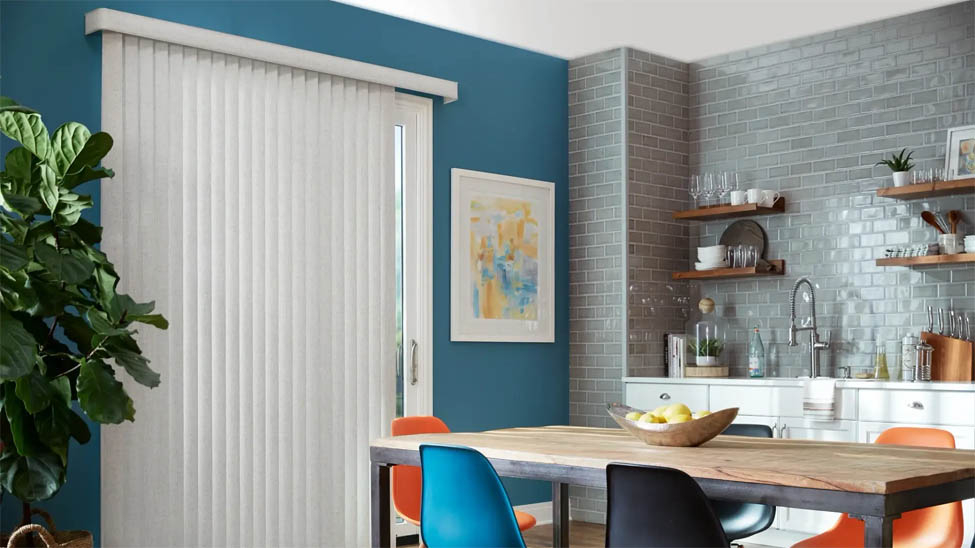
Vertical blinds remain the standard answer because the geometry is right. Vanes hang from a top track, slide to one side or split to both, and rotate to control light without being moved at all. That rotation is the underrated feature: You can angle the vanes for filtered daylight and privacy while the door stays fully usable.
The material choice changes both the look and the performance:
- Fabric vertical blinds: The softest option, closest to drapery in appearance, and the one that best avoids the dated office look older verticals earned.
- PVC vertical blinds: The most common, and also the most practical for moisture and easy wiping, which suits doors onto a pool deck or a wet patio.
- Faux wood vertical blinds: The warmest look of the three, giving a slider the character of wood blinds while still sliding sideways.
When horizontal blinds and shades can work on a slider
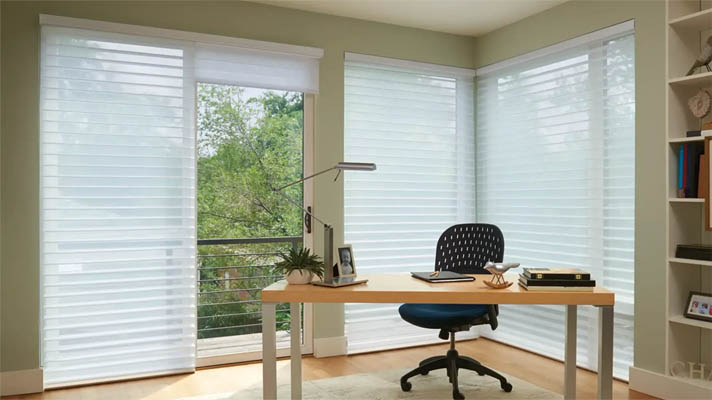
There is a legitimate way to use horizontal blinds or on a sliding door, and it is worth knowing because some rooms need the coordinated look.
Mount two separate blinds side by side across the opening, one over each door panel. You then raise only the blind covering the panel you actually use, leaving the other in place. It works, and it lets a slider match the horizontal blinds on nearby windows.
Be honest about the tradeoffs: Some window treatments, like faux wood blinds, are heavy, raising them is a daily chore compared with sliding a vane stack aside, and there is a visible division down the middle. This suits a door used occasionally, such as a formal room or a guest space, more than a kitchen door used twenty times a day. You'll also need to raise the shade from the floor up overhead to easily pass through. For cordless blinds and shades, this means reaching down for the bottom rail and pulling/pushing it up the full height of the window.
Measuring and mounting around the handle and track
Blinds for sliding doors are almost always outside-mounted, because the frame is too shallow for an inside mount and you need the covering to overlap the trim.
- Width: Measure the full opening and add clearance on each side for the stack, so the gathered vanes sit against the wall rather than over the glass.
- Height: Measure floor to ceiling or to the mounting point, then allow a small clearance at the bottom so the vanes swing freely without dragging.
- Handle projection: Measure how far the handle and lock stand out from the door, and mount far enough forward that nothing collides.
- Stack direction: Decide early whether the covering stacks left, right, or splits to both sides, based on which panel actually slides.
Light, privacy, and heat on a wall of glass
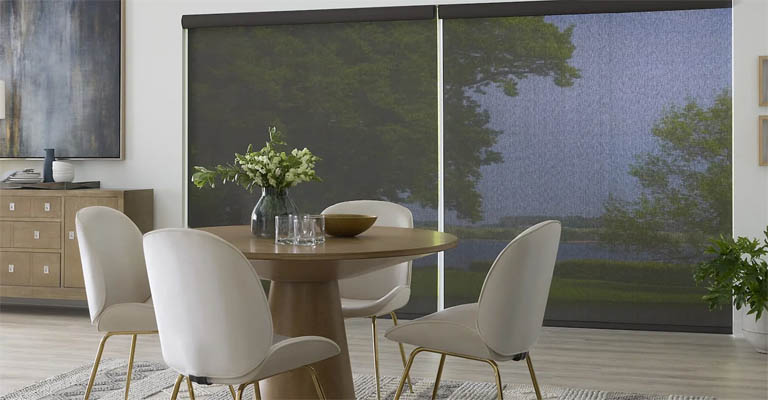
A slider is usually the largest single source of heat gain and heat loss in the room, and often the most exposed to neighbors. Choose a window treatment based on the biggest need while also considering other factors.
- Daytime glare and heat: A solar shade or screen material cuts glare and UV while keeping the view, which suits a door onto a bright patio (although does not provide nighttime privacy).
- Nighttime privacy: Vanes rotated closed give privacy after dark, which matters because a lit room behind a large expanse of glass is highly visible from outside.
- True darkness: A wall of glass is difficult to black out completely, since light passes between any vertical vanes. A bedroom walk-out where maximum darkness is required needs a wide blackout treatment on an outside mount rather than a vaned product.
- Insulation: Closed vanes add a barrier at the glass, which noticeably reduces the draft a large slider throws into the room.
Cover the door the way the door opens
Match the movement first, and everything else follows: Vertical blinds that slide and rotate for a door used daily, paired horizontal blinds only where the door is used occasionally, and an outside mount sized to clear the handle and stack clear of the glass. Browse the range of door blinds and measure the handle before anything else.
FAQs
What kind of blinds are best for sliding glass doors?
Vertical blinds, because they slide sideways in the same direction the door opens and their vanes rotate for light and privacy without being moved. Fabric, PVC, and faux wood vanes suit different rooms.
Can you use horizontal blinds on a sliding glass door?
Yes, by mounting two blinds side by side so you raise only the one covering the panel you use. It suits doors used occasionally, since raising a heavy blind daily is less convenient than sliding vanes aside.
Should sliding door blinds be inside or outside mounted?
Outside mounted, almost always. Door frames are too shallow for an inside mount, and an outside mount lets the covering overlap the trim and clear the handle.
How much clearance do you need for the door handle?
Measure how far the handle and lock project from the door face and mount the covering forward of that, so the vanes or slats never collide with the hardware when the door slides.
Do vertical blinds provide privacy at night?
Yes, when the vanes are rotated closed. That matters on a slider, because a lit room behind a large expanse of glass is very visible from outside after dark.
What is the best way to darken a bedroom sliding door?
A wide blackout treatment on an outside mount that overlaps the frame. Vaned products always leak some light between the vanes, so they are not the choice when full darkness is the priority.
- Blinds for Sliding Glass Doors: The Complete GuideBlinds, Shades & Shutters
- Best Window Blinds for KitchensBlinds, Shades & Shutters
- Blackout Roller Shades vs. Blackout Roman Shades Which Is Right for Your Room?Blinds, Shades & ShuttersHome Advice
- Cordless Faux Wood Blinds: Everything You Need to Know Before You BuyBlinds, Shades & Shutters
- Where to Buy Blinds With the Best Guarantee: What to Compare Before You OrderBlinds, Shades & ShuttersCommon Questions