
Roman Shades for Living Rooms: Styles, Fabrics & How to Choose
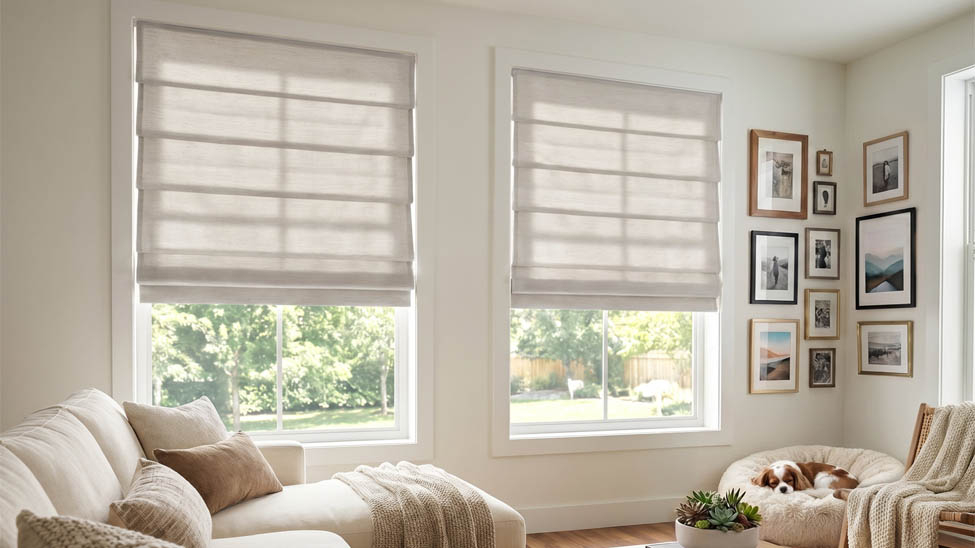
Walk into a living room and the window treatment registers before the sofa does. That is scale rather than vanity. The window is usually the largest surface in the room after the walls, and a roman shade fills it with fabric, color, and texture at eye level. It is also why the fold style carries more weight than people expect, because a flat panel and a cascade of soft loops send completely different signals in the same room, cut from the same cloth.
Flat, plain, or soft fold: Which roman shade style suits a living room
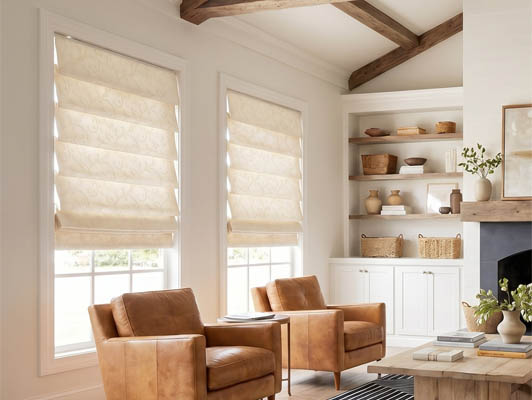
The fold style is the design decision, and it changes the character of the room more than the fabric color does.
- Flat fold: A single unbroken panel with no horizontal seams when lowered. The most modern and minimal of the three, and the best backdrop for a textured or patterned fabric. A flat fold roman shade suits contemporary and transitional rooms.
- Plain fold: Seamed at intervals so it folds neatly and predictably. The most versatile option, tidy when lowered and compact when raised, which makes a plain fold roman shade the safe choice in a room you are still styling.
- Soft fold: Cascading loops of fabric that keep their curves even when the shade is down. A soft fold roman shade reads formal and layered, and it wants a deep sill and a reasonably tall window because it uses more fabric.
A useful rule: The busier the fabric, the flatter the fold should be. Seams and loops compete with pattern.
Choosing fabric weight and texture
Living rooms benefit from fabric with some body. Lightweight material can look thin against a large window and will not hold a crisp fold.
- Textured neutrals: Linen-look weaves and subtle textures add depth without committing the room to a pattern, and they age well as furniture changes.
- Medium weight: Holds its shape, hangs straight, and filters light evenly. This is the sweet spot for most living rooms.
- Pattern: Works best on a flat fold, where nothing interrupts it, and best on one window rather than repeated across a whole wall of glass.
Liners: How much light and privacy you actually get
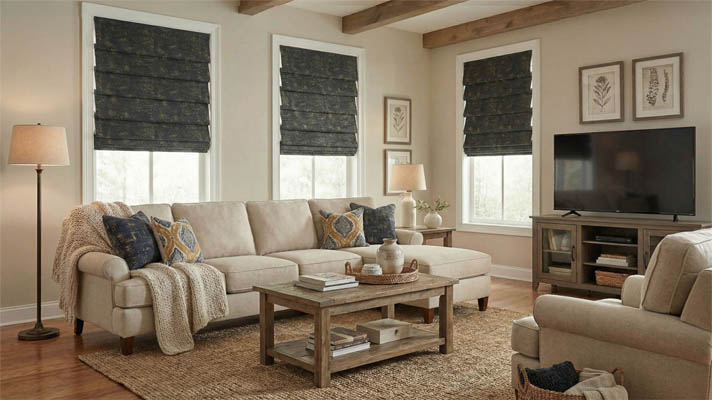
The liner does the functional work, and it is the part people skip past.
A standard light filtering liner softens daylight into an even glow and gives privacy day and night, which is what most living rooms want. A room-darkening or blackout liner steps in when the room doubles as a media space and daytime glare on a screen is the real complaint.
Worth being clear about: A light-filtering Roman shade is already private after dark. You do not need to layer something over it for privacy, only for a deeper level of darkness if you want one.
Inside or outside mount for a living room window
The mount decides the proportions of the wall, and on a big window that matters.
- Inside mount: Sits within the frame for a clean, built-in look that shows off the molding. Best when the trim is attractive and the window is well proportioned.
- Outside mount: Sits above and beyond the opening, which makes the window look larger and taller and hides an awkward frame. It also blocks more light at the edges.
Mounting an outside-mount shade a few inches above the frame is the cheapest way to add apparent ceiling height to a living room.
Large windows, layering, and hands-free operation
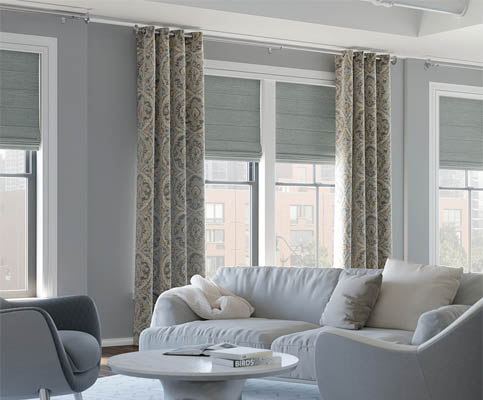
Living room glass is often wide, tall, or both, and that introduces practical constraints.
- Wide openings: Two shades on one line usually look better proportioned and operate more smoothly than a single oversized panel.
- Tall or high windows: A motorized-roman shade makes a shade you would otherwise leave alone genuinely usable, and removes the cord.
- Layering: A roman shade handles light and privacy on its own. Adding side panels is a decorative choice for softness at the edges, not a functional necessity.
- Coordinating: If the room has several window shapes, keeping one fold style and varying only the width holds the wall together.
Let the fold style carry the room
Choose the fold first, because it sets the mood: Flat for modern restraint, plain for everyday versatility, soft for formality. Then pick a fabric with enough weight to hang properly, a liner that matches how the room is used, and a mount that flatters the wall. Browse the full range of roman shades and start with the window the room is built around.
FAQs
Which roman shade style is best for a living room?
Plain fold is the most versatile for everyday living rooms. Flat fold suits modern rooms and bold fabrics, while soft fold brings a formal, layered look and needs a deeper sill and a taller window.
Are roman shades a good choice for large living room windows?
Yes, though very wide openings are usually better covered by two shades on one line than a single oversized panel. That keeps the folds even and the operation smooth.
Do roman shades provide enough privacy for a living room?
Yes. A light-filtering roman shade gives privacy both day and night while keeping the room bright. A room-darkening or blackout liner adds darkness rather than extra privacy.
What fabric works best for roman shades?
Medium-weight fabrics with texture hang best and hold a crisp fold. Very light fabrics can look thin on a large window, and heavy patterns work better on a flat fold where no seams interrupt them.
Should living room roman shades be inside or outside mounted?
An inside mount looks built-in and shows off good trim. Outside mount makes the window appear larger, hides an awkward frame, and blocks more edge light, which suits rooms used for watching television.
Can roman shades be motorized?
Yes. Motorized roman shades are especially useful on tall or hard-to-reach living room windows, and they remove cords, which is safer around children and pets.
- Interior vs. Exterior Plantation Shutters: Which Do You Need?Blinds, Shades & ShuttersHome Advice
- Roman Shades for Living Rooms: Styles, Fabrics & How to ChooseBlinds, Shades & ShuttersHow To
- Blinds for Sliding Glass Doors: The Complete GuideBlinds, Shades & Shutters
- Best Window Blinds for KitchensBlinds, Shades & Shutters
- Blackout Roller Shades vs. Blackout Roman Shades Which Is Right for Your Room?Blinds, Shades & ShuttersHome Advice


